
No products in the cart.
Return To Shop


Operating Room Steel Tables for Surgical Teams
Accurate examination lighting helps clinicians assess skin conditions and other findings. When evaluating the Woods Light-Diagnostic UV Light, consider how the ultraviolet light supports clinical examination and how the device fits into the workflow of a procedure room.
Reliable lighting is essential in clinical environments. The right setup depends on the examination task and how staff position and use the light.
This article explains how the Woods Light-Diagnostic UV Light supports clinical examinations and what to consider when selecting diagnostic lighting. It also considers how Synergy Medical Inc.’s equipment fits into broader room planning, helping clinical teams evaluate the light alongside the surrounding setup.
Key Takeaways
- Review the Woods Light-Diagnostic UV Light’s suitability for its intended clinical use and cleaning environment.
- Match product specifications to the available room space, equipment, and planned workflow.
- Understand which standards and regulatory considerations are relevant to evaluating the products.
- Assess product features and workflow needs across Synergy Medical’s diagnostic and surgical equipment.
What should facilities review when selecting colposcopes?
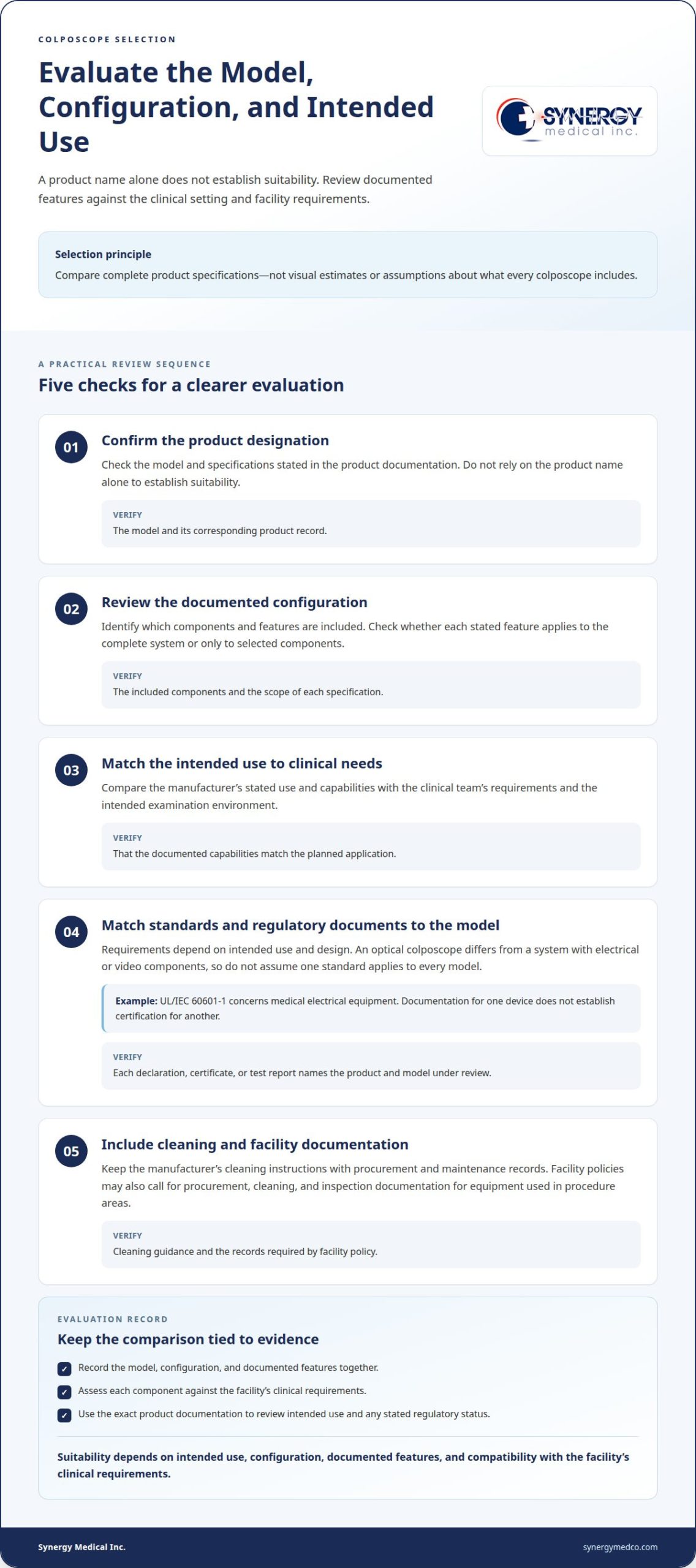
A colposcope’s specifications help determine whether it suits a facility’s clinical needs and workflow. A product name alone does not establish suitability for a specific setting. Intended use, configuration, and documented features matter too. Review the product specifications alongside the facility’s requirements rather than choosing by name alone.
Start with how the colposcope will be used. When reviewing a product, check its documented configuration and whether the stated features apply to the complete system or only selected components. Compare the product record with the needs of the clinical team and the intended examination environment.
- Confirm the product designation. Review the model and specifications stated in the product documentation.
- Review the configuration. Check which components and features are included in the documented system.
- Assess the intended use. Consider whether the product’s stated capabilities match the facility’s clinical requirements.
Facility requirements also inform selection. A colposcope used in a particular clinical setting may need different features from one selected for another workflow. Match the manufacturer’s product information to the facility’s requirements. For example, confirm that the documented configuration meets the clinical team’s needs. Do not assume every colposcope has the same features or configuration.
Compare complete specifications before selecting a colposcope. Look for the model, configuration, features, and product information in one product record. If the system includes multiple components, assess each one against the facility’s requirements. Documented specifications and a clear description of the configuration give procurement and clinical teams a clearer basis for evaluation.
No product designation alone establishes suitability. Choose a colposcope based on intended use, configuration, documented features, and compatibility with the facility’s clinical requirements, and verify which components the stated specifications cover.
What are the standard dimensions and weight capacities of operating room tables?
Evaluate dimensions and weight capacity using each table’s product specifications. No single measurement establishes fit: length, width, height, shelf clearance, and drawer projection each affect room planning. Similarly, a load capacity applies to a stated configuration, not automatically to every table with a similar appearance. Compare the exact model and its published rating before placing it in a procedure room.
Measure the intended position and route into the room. Note doorway clearance, nearby equipment, and the space needed to approach the table. For a table with drawers, include the open drawer in the footprint. A lower shelf also needs clearance for stored equipment and supplies. These checks show whether a table fits the working layout, not just the floor plan.
Use this sequence to assess dimensions and capacity:
- Measure the space. Note the available floor area, access route, and clearance around adjacent equipment.
- Compare table dimensions. Review the listed length, width, and height, then account for shelves and drawers.
- Read the load rating. Identify the manufacturer’s stated capacity and the conditions attached to that rating.
- Assess the intended load. Consider instruments, supplies, and any equipment placed on the table or shelf.
Keep the working load within the published capacity. A shelf’s storage function does not mean it shares the main surface’s rating. Product documentation should clarify which components the capacity covers. For example, a rating may apply to the assembled unit or to a specific surface; use the exact definition provided. If the table needs frequent repositioning, consider how staff will move it when loaded.
Compare specifications across candidate models using the same measurements and load assumptions. This makes differences easier to evaluate without relying on visual estimates. For planning a table setup, review operating room table options alongside the room’s measurements and equipment needs.
There is no single standard dimension or capacity for all tables. Check each model’s listed length, width, height, clearances, and load rating. Confirm which components and configurations the rating covers, then compare it with the intended working load.
What medical standards and regulations apply to colposcopes
Applicable requirements depend on a colposcope’s intended use and design. An optical colposcope differs from a system that includes electrical or video components, so do not assume one standard applies to every model. In the United States, review the manufacturer’s documentation for the specific model, intended use, and any stated regulatory status. A product description alone does not establish compliance.
Separate electrical safety standards from requirements for non-electrical components. UL/IEC 60601-1 concerns medical electrical equipment; its presence in documentation for one device does not establish certification for another. For example, a facility should not infer that a colposcope meets an electrical standard because a medical lighting system has a related certification. Match every certificate or declaration to the exact product and model.
Review documentation to assess regulatory and standards claims:
- Identify the product category. Establish whether it is an optical colposcope or a system with electrical or video components.
- Match documents to the model. Confirm that each declaration, certificate, or test report names the product under review.
- Review intended use. Compare the manufacturer’s stated use with the facility’s planned application.
- Record cleaning guidance. Keep the manufacturer’s instructions with the colposcope’s procurement and maintenance records.
Facility policies add another layer. A hospital may require procurement records, cleaning procedures, and inspection documentation for equipment used in procedure areas. Internal controls do not replace a manufacturer’s certification or regulatory documentation. For example, an infection-prevention policy can specify approved cleaning agents, while the manufacturer’s instructions identify compatible products and surfaces. Keep both references available to staff.
Assess the colposcope’s design and documentation together. Accessible surfaces and care instructions help teams evaluate cleaning practices, but they do not prove regulatory compliance. Check what each document covers, which model it names, and whether its stated use matches the intended application. This helps prevent a standard for one device category from being mistaken for proof relating to another.
Synergy Medical Inc.: Colposcopes for clinical use
Synergy Medical Inc. offers colposcopes as part of its medical equipment selection. When evaluating a colposcope, consider its intended use, placement, and the examination workflow. A purchasing team can review how the device fits the clinical setting and how staff will access it during an examination. Magnification and positioning also shape how the colposcope supports examination needs.
Before selecting a colposcope, bring the practical details into one review. Room measurements establish where the device can sit and how staff will approach it. Documented specifications help determine whether the model suits the intended setup. Cleaning guidance and product information support routine-care planning. Together, these criteria connect product specifications to the actual room and workflow.
- Use: Define the examination needs the colposcope will support.
- Access: Note how staff will position and operate the colposcope during examinations.
- Placement: Consider nearby equipment, staff movement, and the device’s full footprint.
- Documentation: Review the specific model’s specifications, care instructions, and configuration.
Room planning may also involve adjacent equipment. For example, teams coordinating colposcope placement with illumination can consider Synergy Medical Inc.’s medical lighting systems. Facilities planning connected systems may also review its video integration solutions. These offerings address separate equipment needs; they do not replace the colposcope’s specifications or documentation. Keeping each product’s function clear makes procurement discussions more focused.
For teams comparing colposcopes, organize requirements around workflow, room layout, positioning, and care. This gives procurement discussions a practical basis without assuming one configuration fits every clinical setting. Contact Synergy Medical Inc. to discuss its colposcopes and related equipment needs.
Contact Synergy Medical Inc. about colposcopes
Plan the next step for your operating room
Use your facility’s workflow and procurement priorities to guide the next discussion about operating room steel tables. A table is one part of a room’s equipment plan, and neighboring needs can shape purchasing priorities. Synergy Medical Inc. offers Surgical Monitors, Radiology Monitors, and Mammography monitors for facilities planning diagnostic and surgical display requirements alongside other equipment. These are separate product categories, so assess each for its intended use.
As your team moves from research to selection, bring its operating requirements into the conversation. This keeps the discussion focused on how the table will support the room, rather than on assumptions about a standard configuration. Clear priorities help identify the product information most relevant to the decision.
A considered equipment plan gives your team a practical foundation for its next procurement decision.
Frequently Asked Questions
What types of stainless steel tables are used in operating rooms?
Common types include instrument tables, mayo stands, and tables with added storage. Instrument tables organize supplies, while mayo stands position selected items close to the operative field. Storage-oriented designs may include drawers or shelves. For example, a team preparing a workstation can choose a table style based on whether it needs nearby instrument access, extra storage, or a separate stand for specific supplies.
How should stainless steel operating room tables be cleaned and disinfected?
Follow the manufacturer’s care instructions and confirm that cleaning agents are compatible with the table’s documented finish. Keep cleaning guidance with the table’s maintenance records.
What are common safety risks and maintenance requirements for operating room tables?
Keep the working load within the published capacity and confirm which components and configurations the rating covers. Facility policies may also require cleaning procedures and inspection documentation.
Which manufacturers sell operating room stainless steel tables in the US?
Synergy Medical Inc. offers steel tables for the operating room.
About author
