
No products in the cart.
Return To Shop


Mammography Monitor Requirements in 2026: FDA Rules, Display Performance, and QC
What should a mammography monitor meet for diagnostic interpretation: a set resolution, FDA clearance, or documented quality control? There is no single specification that answers every part of the question. Mammography monitor requirements cover both facility-level responsibilities and the evaluation of a display for its intended clinical use. The FDA does not mandate a specific monitor resolution. A 5-megapixel display is commonly cited as an industry minimum for interpretation, while FDA clearance for mammography use is recommended rather than required by MQSA.
This distinction matters when a facility assesses compliance and decides whether a display fits its clinical workflow. The FDA’s MQSA rule changes took effect on September 10, 2024, but they do not establish a universal monitor specification. This article explains how MQSA responsibilities relate to display performance, what to document with qualified personnel, and how quality-control procedures fit into the evaluation. It also covers manufacturer guidance and the 2018 ACR Digital Mammography Quality Control Manual, so facilities can distinguish recommendations from binding requirements.
Key Takeaways
- Separate facility-level MQSA responsibilities from the evaluation of an individual display when reviewing mammography monitor requirements.
- Assess resolution, luminance, grayscale presentation, and calibration together as parts of diagnostic image display performance.
- Organize documentation around intended use, display details, installation context, testing, and ongoing quality control.
- Compare monitor options with the facility’s modality and interpretation workflow, involving qualified personnel in defining testing and QC needs.
Mammography Monitor Requirements: Separate MQSA Facility Rules from Display Guidance
Mammography monitor requirements involve two related but distinct areas: a facility’s MQSA compliance and the performance and quality control of the displays used for interpretation. MQSA governs the facility’s mammography program; it does not reduce display evaluation to one universal monitor specification. Keeping these areas separate helps teams avoid treating facility certification, accreditation criteria, and display recommendations as interchangeable.
What does MQSA regulate at the facility level?
The FDA’s MQSA regulations in 21 CFR Part 900 set requirements for covered facilities, including certification, accreditation, image quality, and quality assurance. Facilities are subject to inspection at least annually by a certified MQSA inspector. Separately, diagnostic review workstations must be tested by a qualified medical physicist before clinical use and regularly thereafter, following the manufacturer’s QC manual or the 2018 ACR Digital Mammography Quality Control Manual as an FDA-approved alternative. These responsibilities concern the facility’s program and equipment oversight, not a single resolution number. The Mammography Quality Standards Act (MQSA) provides general background on the law.
Is an FFDM-cleared monitor always a legal requirement?
No universal MQSA rule requires every interpretation monitor to have FDA clearance specifically for Full-Field Digital Mammography (FFDM) or Digital Breast Tomosynthesis (DBT). FDA guidance recommends displays cleared for those uses, and the ACR strongly recommends FDA-cleared monitors for interpretation. A recommendation should not be described as a binding legal mandate. Accreditation criteria and facility procedures may also shape a site’s requirements. The ACR’s FDA equipment guidance distinguishes cleared displays from other monitors that may legally be used. Facilities should document the basis for their selection and apply the appropriate QC process.
For a practical evaluation, connect the intended clinical use with display documentation and physicist-led testing rather than relying on a product label alone. Synergy Medical Inc. distributes diagnostic monitors and provides project consultation and design assistance for facilities assessing display options.
Mammography Display Performance: Evaluate the Whole Diagnostic Image Chain
A monitor’s resolution alone cannot establish whether it is suitable for mammography interpretation. Diagnostic suitability depends on how resolution, luminance, grayscale presentation, calibration, and viewing conditions work together in the clinical image chain. The mammography monitor requirements a facility applies should reflect the intended modality and interpretation task. Technical criteria should be grounded in current manufacturer documentation and applicable professional guidance.
Which display characteristics should a facility assess?
Review the display as part of the complete workstation, not as an isolated panel. Resolution affects the detail available on screen. Luminance and grayscale behavior affect how image tones are presented, while calibration supports consistent display performance. Ambient viewing conditions also matter because room lighting can affect how images appear to the reader.
Record the display specifications relevant to its intended use and the results of applicable testing. Assess both against the manufacturer’s instructions and the facility’s QC process. Avoid adopting a numerical threshold without a current, relevant source.
DICOM, or Digital Imaging and Communications in Medicine, is a standard for handling, storing, and transmitting medical images. DICOM compatibility alone does not establish that a monitor is appropriate for diagnostic interpretation. DICOM Part 14 describes the Grayscale Standard Display Function (GSDF), which supports calibrated grayscale presentation. It does not replace evaluation of the monitor and workstation in their clinical setting.
How do FFDM and DBT affect display evaluation?
Full-Field Digital Mammography (FFDM) and Digital Breast Tomosynthesis (DBT) involve different interpretation tasks. DBT includes reconstructed thin-section images, so consider the workflow and display use when assessing whether a workstation meets documented clinical needs. The Final Rule to Amend MQSA Regulations, effective September 10, 2024, updates facility standards. It should not be read as setting one universal display specification.
For diagnostic-display planning, Synergy Medical Inc.’s diagnostic monitor options can be considered alongside project consultation and design assistance. Match the evaluation to the modality, workflow, and documented facility criteria.
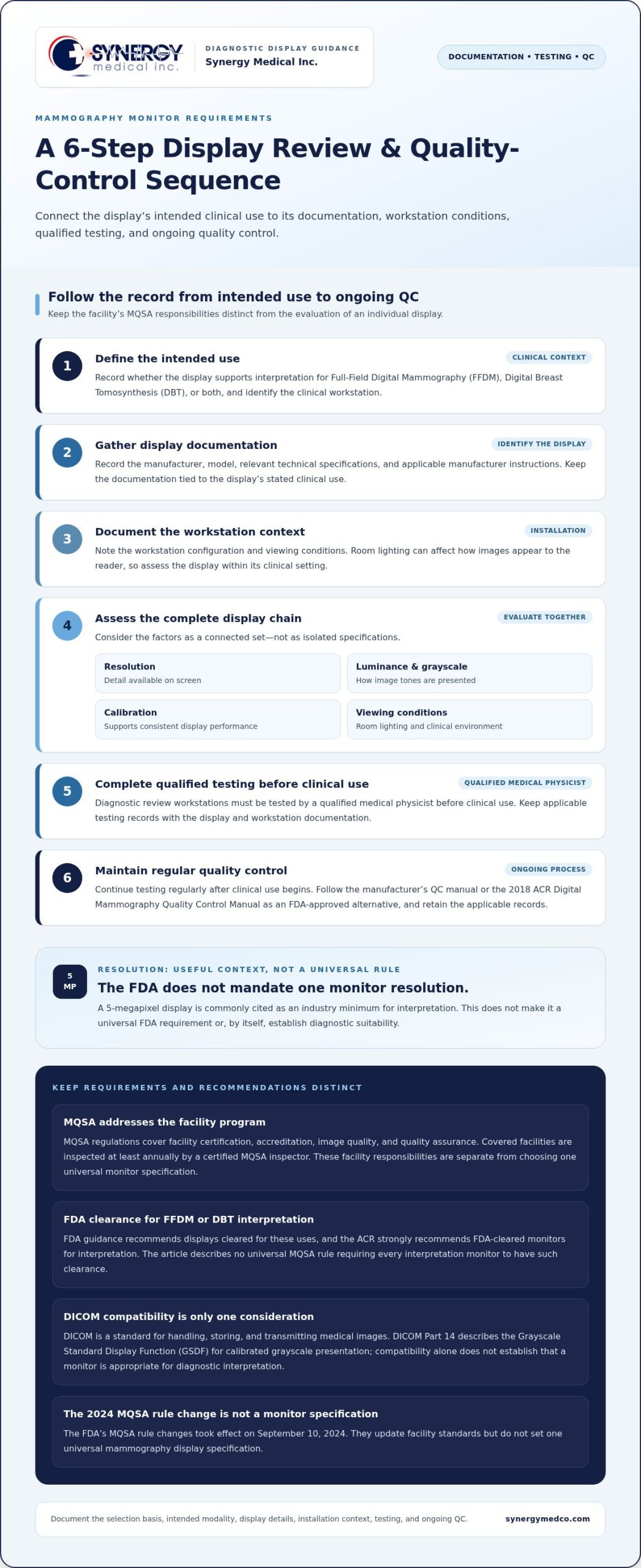
Mammography Monitor Requirements Checklist: Documentation, Testing, and QC
A consistent review sequence connects a display’s stated capabilities with its intended clinical use and the facility’s quality-assurance records. For mammography monitor requirements, document the decision at each step and assign technical evaluation to qualified personnel.
- Define intended use. Record whether the display supports FFDM or DBT interpretation and identify the clinical workstation.
- Gather display documentation. Record the manufacturer, model, relevant technical specifications, and applicable instructions.
- Document installation context. Note the workstation configuration and viewing conditions that may affect image presentation.
- Review testing. Keep applicable acceptance-testing, calibration, and equipment-evaluation records.
- Maintain ongoing QC. File results, corrective actions, and the schedule established under applicable instructions and facility procedures.
What should the mammography monitor review document?
Keep display records with the facility’s quality-assurance documentation. Include the intended use, model, technical documents, and applicable manufacturer instructions. Link testing results to the workstation and date of evaluation, and record who performed or reviewed the work. A clear record should let reviewers trace a finding, response, and follow-up. A product specification by itself does not establish clinical suitability.
How should facilities approach calibration and ongoing QC?
Use the manufacturer’s QC manual or the 2018 ACR Digital Mammography Quality Control Manual as the applicable FDA-approved alternative, as appropriate to the facility’s program. Diagnostic review workstations must be tested by a qualified medical physicist before clinical use and regularly thereafter. Document the physicist’s role, facility procedures, manufacturer instructions, and accreditation criteria distinctly.
Do not assume a universal calibration interval or acceptance threshold. Record the source for each interval and criterion, then verify it against current applicable guidance, device instructions, and facility requirements. This makes the QC schedule traceable and supports consistent review when equipment or workflow changes.
Review diagnostic monitor options with Synergy Medical Inc. as part of your display planning.
Selecting Mammography Monitors for a Facility: Match the Display to the Clinical Workflow
Start selection with the clinical task, not a model name or a single headline specification. Document the modality, interpretation workflow, room conditions, and facility protocols, then compare options using current manufacturer documentation. This creates a traceable basis for evaluating mammography monitor requirements without treating one feature as proof of suitability.
What information should procurement gather before selecting a display?
Before comparing displays, record whether the workstation will support FFDM, DBT, or both, who will interpret images, and how the display fits into the existing workflow. Include relevant room conditions and facility procedures. Compare specifications documented by the manufacturer and applicable to the intended use. Have qualified personnel define technical criteria and testing needs.
Comparison factor | What to record
Intended use | FFDM or DBT workflow and interpretation task
Verified specifications | Manufacturer-documented display characteristics relevant to that use
Documentation | Product materials and applicable instructions
QC support needs | Testing and ongoing quality-control requirements defined by facility procedures and qualified personnel
How can a distributor support display planning?
Synergy Medical Inc. distributes mammography and radiology monitors from multiple manufacturers and provides project consultation and design assistance. This support can help facilities organize display options around documented workflow needs. It does not replace the facility’s compliance decisions. The diagnostic monitor offerings can be considered as part of a project-fit discussion. Keep model-specific suitability and technical values tied to current documentation and the facility’s evaluation process.
A clear comparison record gives clinical, technical, and procurement teams a shared basis for review. Discuss mammography monitor requirements with Synergy Medical Inc.
Turn Display Evaluation Into a Clear Project Plan
Translate clinical needs into documented selection criteria. Bring the interpretation workflow, facility protocols, and display records together so clinical, technical, and procurement teams can evaluate the same requirements. This gives qualified personnel a clear basis for reviewing technical details and planning testing without treating a single specification as a substitute for the full assessment.
Keep the criteria current as modalities, workstations, or workflows change. A disciplined review makes mammography monitor requirements easier to apply during procurement and ongoing quality assurance, while leaving compliance decisions with the facility and its qualified personnel.
Plan your mammography display project with Synergy Medical Inc.
A well-defined plan supports informed decisions at each stage, from display evaluation through clinical use. Explore Synergy Medical’s diagnostic monitor options and start planning your display project.
Frequently Asked Questions
Does the FDA require every mammography monitor to be specifically cleared for FFDM?
No. For a particular workstation, review the display’s labeling and supporting manufacturer documentation alongside its intended clinical use. Record the model and the basis for selecting it, including how it fits the facility’s interpretation workflow. This gives procurement and clinical teams a traceable decision record and helps distinguish evidence about a specific display from assumptions based on its product category.
Does MQSA require every mammography facility to maintain a printer?
No. The ACR summary says each facility decides whether to maintain a printer. If a facility uses one, applicable printer QC requirements still apply, including manufacturer procedures and medical-physicist involvement described in the guidance. For example, a facility that provides digital images may have a different printing workflow from one that prints images. Verify current requirements for the facility’s equipment, accreditation pathway, and QC program.
Can digital mammography images replace hard-copy film?
They may be provided in place of hard-copy films in certain circumstances, according to the ACR summary. It describes final-interpretation-quality hard-copy films or original or lossless-compressed digital images as options when acceptable to the recipient, such as in a transfer between FFDM facilities. The format depends on the purpose and recipient. Before setting transfer or retention procedures, verify current FDA guidance and applicable facility protocols.
How often should a mammography monitor be calibrated?
The schedule should be defined for the specific display and workstation. For useful records, tie each calibration entry to the display’s model or identifier, the date, the procedure performed, results, and any follow-up action. Keep the record with the workstation’s quality documentation so reviewers can trace its history. If a display or workstation configuration changes, document the evaluation in accordance with the facility’s established process.
About author
